
What Feelings Buddy is for
Feelings Buddy is for working through feelings with self-compassion, toward self-acceptance and self-motivation. A hard feeling is the obstacle, not the destination.
Some feelings are hard to feel: sadness, anger, disappointment, guilt, regret, numbness. They often start with something that changed or ended, or a future you wanted that didn't happen. A loss is one of the plainest cases: a death, a separation, a job, your health. Either way, feeling it without avoiding it is worth doing. A feeling you haven't felt can keep a pattern running: the same harsh voice, the same reaction, the same plan that never starts. Feeling it is the way in.
A session is built around that. You feel what's there. You meet the harsh voice with kindness. You find what you're accepting, about what happened and about yourself. Then you see what's in your hands, if anything is. Self-motivation comes out of what you felt, in your own words, or it waits for another day. "Nothing to do today, I felt it" is a complete session.
The principles behind Feelings Buddy
A hard feeling is not a problem to solve. It points at something that mattered: a person, a plan, a future you wanted. Grief is the plainest case: love and a wanted future with nowhere to go. A feeling you keep avoiding shows up as the harsh voice, the stalled plan, the reaction that doesn't fit the moment.
Self-compassion is what lets you feel something hard without being flattened by it. It is also what turns acceptance into motivation.
A feeling that stays heavy is not a failing, and it needs a person. The research on this is about grief after a death. Therapy built for grief that stays this heavy did better than a standard therapy in a trial, and therapy for people whose grief is severe shows clearer effects than therapy offered to all bereaved people. A session is not therapy, it does not treat prolonged grief, and it does not replace therapy for grief that stays very heavy. It does not replace therapy for any other feeling that stays this heavy either.
A fair objection is that an AI cannot understand what you feel. Feelings Buddy does not claim to. It follows what you bring and never brings in a loss or a person you did not mention.
What a session does
A session is one conversation about one thing that's been hard, with a presence that is curious, unhurried and kind. It follows what you bring rather than a script, and it usually passes through these places:
- Arrive. What you want to look at today, how your body is doing, and a minute of slow breathing if you want it.
- Open it up. One specific moment rather than the whole story: what you saw, what was said, what you never got to say.
- Feel it. Staying with the feeling that's there: where it sits in your body, what it's like, what it wants. Nothing has to be fixed.
- Meet the harsh voice. Self-blame and what-ifs are met with compassion, and you're asked how a kinder voice of your own would put it.
- Accept. What you're accepting today, about what happened and about yourself. "I'm not there yet" is an answer.
- What's in your hands. Whether anything wants to move, today or this week. The step is always yours, and "Nothing to do today, I felt it" is a complete answer.
- Close. What it saw happen in you today, a line you could take to a therapist or someone you trust, and who in your life could hear some of this. If topics came up that research has looked at, it also gives the key points in your words and offers a research report.
Feelings Buddy may offer a feeling or a connection you haven't named, always as a question you can wave away: "I wonder if there's some anger in there too?" If you only want to be heard, it listens. If you say "not today", that is the session.
An example
An example, written for this page; not a real person's words. Square brackets mark turns left out.
Opening card: Shown by the page before the first message: the kinds of things people bring, then "What would you like to look at today?"
Person
got laid off 2 months ago. 20 yrs same company. honestly im fine i just dont feel anything about it
Feelings Buddy
Twenty years in one place, over, and inside there's mostly quiet. I'm not going to try to talk you out of the quiet. What has it been like, these weeks since?
Person
weird. i keep waking up at 5 like i still have to be somewhere
Feelings Buddy
So your body is still on the old schedule, with nowhere to go. How's it doing right now? If a number helps: 1 is flat, 5 is steady, 10 is flooded.
Person
3 i guess. flat is about right
Feelings Buddy
Flat, then. How are you sleeping and eating, and are you getting out much?
What you keep
The report and research report below were written for this page from the example above. They are not a real person's words.
Session report · An example
Like he still had somewhere to be
You came in having been laid off two months ago after "20 yrs same company", saying "honestly im fine i just dont feel anything about it."
- Your messages
- 21
- Written from
- Your own words
Opening it up and feeling it
What was underneath
The nothing turned out to be "more like i keep feeling like im failing at something. dont know what." You felt it in your jaw, and your wife says you grind your teeth at night now. When you imagined your jaw speaking, it said "shut up and keep going." You traced that to your dad, who was let go from the mill when you were 11, never talked about it, and "just went out every morning anyway like he still had somewhere to be." When the guide set that beside you being up at 5 a.m., you said "i didnt see that til just now." Then came the heaviness in your shoulders and "sad i think. for him mostly," and the thought that "he was younger than i am now when it happened."
What shifted
You started at a 3, "flat is about right," and said you were fine. By the end you said "it was a big deal. 20 yrs. i keep saying its fine and its not." After you said your own words to yourself, "shoulders went down a bit. still sad." You ended at a 4: "less flat. tired."
When you end a session, you choose whether to save its report. It is written from your own words. After two saved reports, your dashboard shows what runs across your sessions.
When you save the report, you can also ask for a research report. Feelings Buddy's AI research assistant reads the conversation and anything you asked it to cover, looks up what research says about each topic, and writes a PDF: what was happening, what research says, and what you could do now.
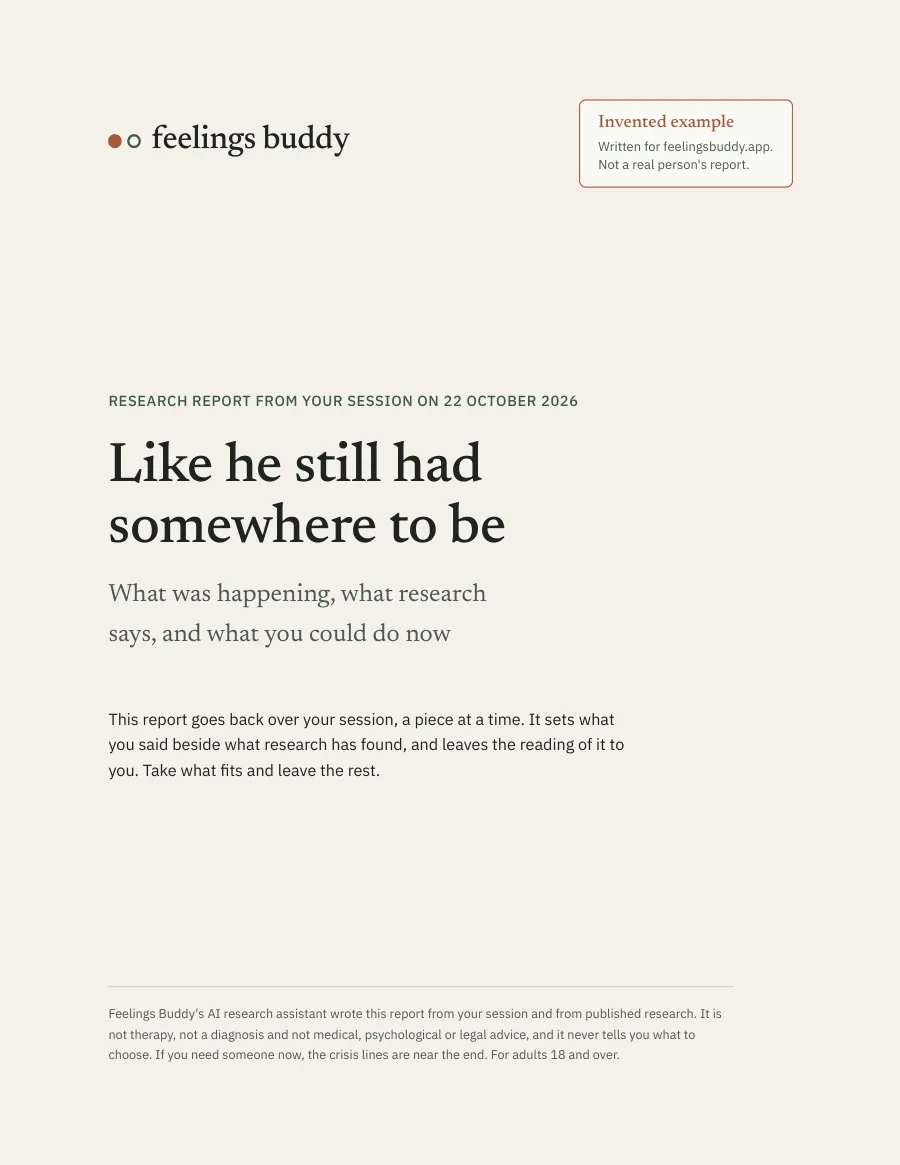
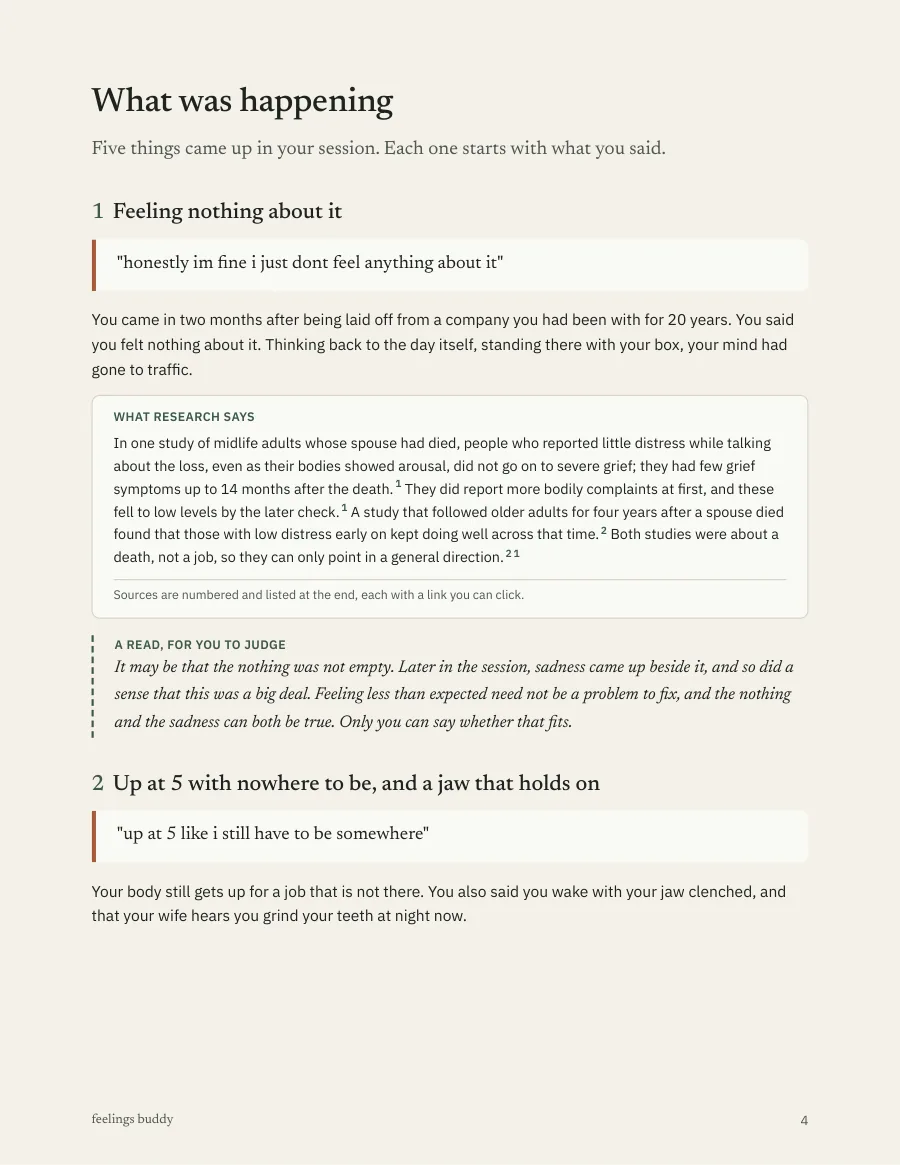
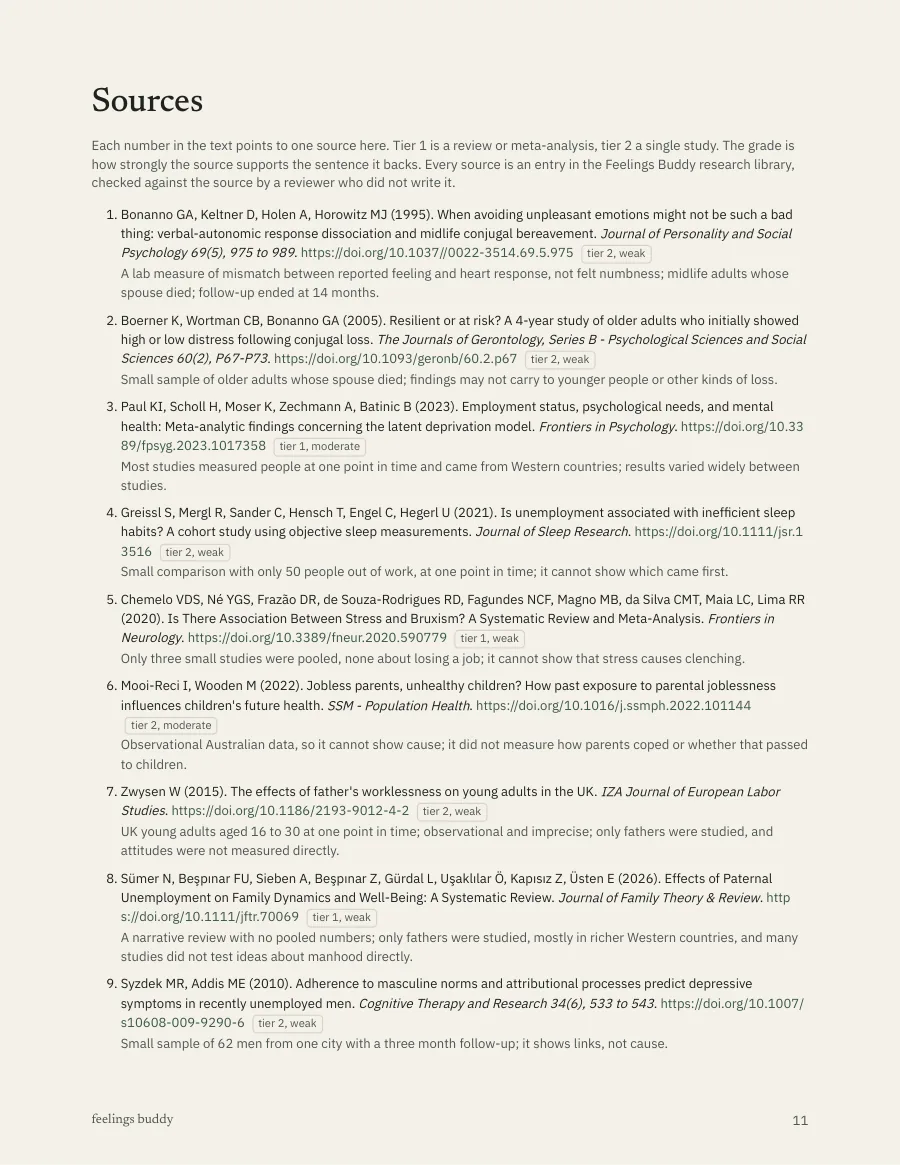
Open the example research report (PDF, 12 pages)
Every research sentence is numbered, and the sources are listed at the end with links. It is often ready within the hour, or the next day if it's asked for overnight, and up to 2 days if it needs research we haven't done yet. We email you a link, and the PDF is kept with that session until you delete it.
It is not therapy or a diagnosis, and it never tells you what to choose.
What each step draws on
Each step draws on research. Where a study was of bereaved people, or of people who were not grieving, the line says so. A finding from bereaved people is about grief after a death, not about every hard feeling.
Rest counts
"Not today" ends a session, and it counts as rest.
What the research says 1 study
- The dual process model, written about coping after a death, describes moving back and forth between facing the loss and getting on with life, with breaks from both counted as coping. It is a model, not a tested finding. Stroebe & Schut, 1999, Death Studies
Feel it, one moment at a time
One moment: what it was like, not why. It never pushes.
What the research says 4 studies
- Putting a feeling into words lowered the brain's response to upsetting images. Lieberman et al., 2007, Psychological ScienceNot grieving
- In a fear study, it lowered a body measure of arousal, but not how afraid people said they felt. Kircanski, Lieberman & Craske, 2012, Psychological ScienceNot grieving
- Asking how a painful moment feels was easier on mood than asking why it happened. Watkins, 2008, Psychological BulletinNot grieving
- In two long studies of bereaved people, sharing more emotion about the loss did not go with better adjustment, which is why a session never pushes. Stroebe et al., 2002, Journal of Consulting and Clinical PsychologyBereaved people
Kindness for the what-ifs
Regret is held; the case against you is never agreed with.
What the research says 3 studies
- A short self-compassion prompt after a failure or a wrong moved students and online adults toward repair. Breines & Chen, 2012, Personality and Social Psychology BulletinNot grieving
- A review of mostly correlational research linked judging a specific act, rather than your whole self, with apology and repair. Tangney, Stuewig & Mashek, 2007, Annual Review of Psychology
- Among bereaved spouses, self-blame went with heavier grief over two years, and regret did not. Stroebe et al., 2014, PLOS ONEBereaved people
A kinder voice
One question: how would a compassionate voice put it? Grounding comes first if you arrive flooded.
What the research says 2 studies
- That question is self-compassion in one sentence: kindness to yourself, knowing you are not the only one, and seeing the pain clearly without drowning in it. Neff, 2003, Self and Identity
- Across 27 randomized trials, self-compassion programmes improved self-criticism and mood. A session asks one question and is not a programme. Ferrari et al., 2019, MindfulnessNot grieving
Accept yourself
Acceptance is not being fine or letting go. A session asks what you are accepting.
What the research says 1 study
- In three studies, people who met a regret with self-compassion accepted it more and reported more improvement, and acceptance carried part of that link. Zhang & Chen, 2016, Personality and Social Psychology BulletinNot grieving
What's in your hands
A step is always yours, and a session never suggests one. A saved step may be asked about once; "I didn't" is met with kindness.
What the research says 4 studies
- Self-compassion after a failure raised motivation to improve. Breines & Chen, 2012, Personality and Social Psychology BulletinNot grieving
- In a study of students, self-compassion went with active effort toward a fuller life. Neff, Rude & Kirkpatrick, 2006, Journal of Research in PersonalityNot grieving
- Goals that fit a person's own interests and values drew more sustained effort. Sheldon & Elliot, 1999, Journal of Personality and Social PsychologyNot grieving
- In a large trial of single online sessions for depression, nearly every session lifted mood straight after, but only two of twelve still lowered depression four weeks later. So a good feeling at the end is not the goal, and a session does not end on a promise. Kaveladze et al., 2026, Nature Human Behaviour
Back to your people
It closes on who could hear some of this. "No one yet" is an answer, and it never says "I'll always be here".
What the research says 1 study
- In an Australian survey of bereaved people, family and friends were the most common source of support. Aoun et al., 2015, PLOS ONEBereaved people
No stages
A session never names or predicts a stage.
What the research says 2 studies
- The stage theory of grief lacks sound evidence. Stroebe, Schut & Boerner, 2017, OMEGA
- In one long study of older adults who lost a spouse, the most common pattern was steady, low distress. Bonanno et al., 2002, Journal of Personality and Social PsychologyBereaved people
Sources: 20 studies and reviews
- Stroebe MS, Schut HAW (1999). The Dual Process Model of coping with bereavement: Rationale and description. Death Studies 23(3), 197-224
- Lieberman MD, Eisenberger NI, Crockett MJ, Tom SM, Pfeifer JH, Way BM (2007). Putting feelings into words: affect labeling disrupts amygdala activity in response to affective stimuli. Psychological Science
- Kircanski K, Lieberman MD, Craske MG (2012). Feelings into words: contributions of language to exposure therapy. Psychological Science
- Watkins ER (2008). Constructive and unconstructive repetitive thought. Psychological Bulletin 134(2), 163-206
- Stroebe M, Stroebe W, Schut H, Zech E, van den Bout J (2002). Does disclosure of emotions facilitate recovery from bereavement? Evidence from two prospective studies. Journal of Consulting and Clinical Psychology 70(1)
- Breines JG, Chen S (2012). Self-Compassion Increases Self-Improvement Motivation. Personality and Social Psychology Bulletin 38(9), 1133-1143
- Tangney JP, Stuewig J, Mashek DJ (2007). Moral Emotions and Moral Behavior. Annual Review of Psychology 58, 345-372
- Stroebe M, Stroebe W, van de Schoot R, Schut H, Abakoumkin G, Li J (2014). Guilt in Bereavement: The Role of Self-Blame and Regret in Coping with Loss. PLOS ONE 9(5)
- Neff KD (2003). The Development and Validation of a Scale to Measure Self-Compassion. Self and Identity 2, 223-250
- Ferrari M, Hunt C, Harrysunker A, Abbott MJ, Beath AP, Einstein DA (2019). Self-Compassion Interventions and Psychosocial Outcomes: a Meta-Analysis of RCTs. Mindfulness 10(8), 1455-1473
- Zhang JW, Chen S (2016). Self-Compassion Promotes Personal Improvement From Regret Experiences via Acceptance. Personality and Social Psychology Bulletin 42(2), 244-258
- Neff KD, Rude SS, Kirkpatrick KL (2006). An examination of self-compassion in relation to positive psychological functioning and personality traits. Journal of Research in Personality 41, 908-916
- Sheldon KM, Elliot AJ (1999). Goal striving, need satisfaction, and longitudinal well-being: The self-concordance model. Journal of Personality and Social Psychology 76(3), 482-497
- Kaveladze BT, Voelkel JG, Stagnaro MN, et al. (2026). A crowdsourced megastudy of 12 digital single-session interventions for depression in US adults. Nature Human Behaviour 10(5), 906-922
- Aoun SM, Breen LJ, Howting DA, Rumbold B, McNamara B, Hegney D (2015). Who Needs Bereavement Support? A Population Based Survey of Bereavement Risk and Support Need. PLoS ONE
- Stroebe M, Schut H, Boerner K (2017). Cautioning Health-Care Professionals: Bereaved Persons Are Misguided Through the Stages of Grief. OMEGA - Journal of Death and Dying 74(4), 455-473
- Bonanno GA, Wortman CB, Lehman DR, et al. (2002). Resilience to Loss and Chronic Grief: A Prospective Study From Preloss to 18-Months Postloss. Journal of Personality and Social Psychology 83(5), 1150-1164
- Shear K, Frank E, Houck PR, Reynolds CF (2005). Treatment of complicated grief: a randomized controlled trial. JAMA
- Currier JM, Neimeyer RA, Berman JS (2008). The effectiveness of psychotherapeutic interventions for bereaved persons: a comprehensive quantitative review. Psychological Bulletin 134(5)
- Wittouck C, Van Autreve S, De Jaegere E, Portzky G, van Heeringen K (2011). The prevention and treatment of complicated grief: a meta-analysis. Clinical Psychology Review 31(1)
Who it is not for
Feelings Buddy is for adults 18 and over, in Canada outside Quebec. It is not the place to turn first if you might not be safe now. Its instructions say never to speak as, role-play or write as the person who was lost.
If grief has been heavy most days for a long time and gets in the way of daily life, a session says once that this is worth taking to a therapist. A family doctor, or a therapist who works with grief, can help you work out what kind of support fits. The crisis lines are at the foot of this page.